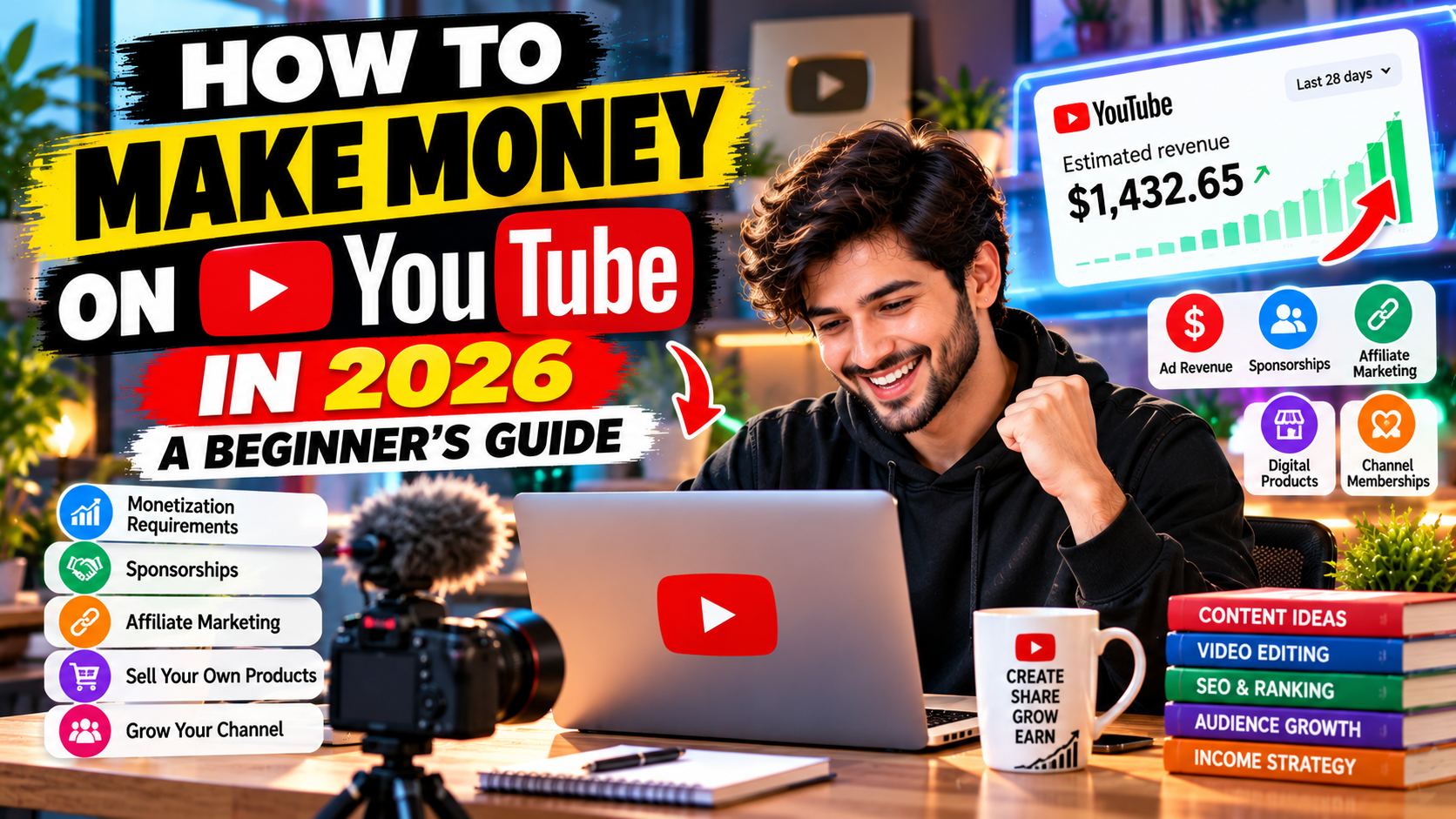
How to Make Money on YouTube in 2026: A Beginner’s Guide YouTube can be more than a place to watch videos. For people who enjoy teaching, reviewing products, sharing ideas, or creating entertaining content, it can become a long-term creative project with several potential income sources.
However, earning money on YouTube is not as simple as uploading a few videos and waiting for payments. Creators need to understand their audience, publish useful content, and follow the platform’s rules.
If you want to learn how to make money on YouTube, this guide explains the main earning methods, the requirements for monetization, and practical steps for getting started.
1. Choose a YouTube Niche
Before recording your first video, decide what your channel will be about. A clear topic helps viewers understand what they can expect from your content.
Some possible niches include:
- Technology: Tutorials, app guides, and device explanations.
- Education: Lessons, study tips, and explanations of difficult concepts.
- Gaming: Gameplay, strategies, and original commentary.
- Cooking: Recipes, kitchen techniques, and food preparation.
- DIY and crafts: Projects, demonstrations, and practical skills.
- Personal development: Productivity, learning habits, and organisation.
Choose a subject you understand or are willing to research properly. You do not need to cover every popular topic. A focused channel can make it easier to develop a recognisable style and attract viewers interested in the same subject.
2. Make Videos That Solve a Problem
A useful video gives viewers a reason to click and continue watching. Instead of choosing a topic only because it is trending, consider what people want to learn or understand.
For example, a technology channel might explain how to use a phone feature, compare software functions, or troubleshoot a common setting.
Before recording, write a short outline:
- 1. Introduce the topic and explain what viewers will learn.
- 2. Present the steps or main information in a logical order.
- 3. Demonstrate the process when possible.
- 4. Summarise the key points and suggest a relevant next step.
A clear explanation is often more valuable than expensive equipment. Start with the tools you have, pay attention to audio quality, and improve your editing as you gain experience.
3. Earn Through the YouTube Partner Program
The YouTube Partner Program (YPP) provides eligible creators with access to monetization features, including advertising revenue sharing.
For the main advertising revenue thresholds, YouTube currently lists two routes:
- Long-form videos: 1,000 subscribers and 4,000 valid public watch hours during the previous 12 months.
- Shorts: 1,000 subscribers and 10 million valid public Shorts views during the previous 90 days.
Watch time from the Shorts Feed does not count toward the 4,000-hour long-form requirement. Meeting a threshold does not automatically guarantee approval; the channel must also pass YouTube’s review and comply with its policies.
YouTube may offer certain eligible creators access to some other monetization features at lower thresholds. Requirements vary by feature and location, so check the Earn section in YouTube Studio and the official eligibility guidance before making plans.
4. Understand YouTube Advertising Revenue
Once a channel qualifies for the relevant advertising features and is accepted into YPP, eligible videos may earn revenue from ads.
Earnings vary widely. They depend on factors such as the viewers’ locations, video topic, advertiser demand, audience engagement, video length, and the types of ads served.
For that reason, there is no reliable universal amount that every creator earns per 1,000 views. A video with many views does not necessarily earn more than every video with fewer views.
Focus first on creating videos that people find useful or enjoyable. Revenue estimates should be treated as estimates rather than promises.
5. Explore Affiliate Marketing
Affiliate marketing allows creators to earn a commission when viewers purchase eligible products through their tracked links.
For example, a technology creator might review a microphone, explain its strengths and limitations, and provide an affiliate link where permitted.
To make this approach useful and trustworthy:
- Recommend products relevant to your audience.
- Give honest opinions and explain limitations.
- Check the affiliate programme’s terms.
- Clearly disclose affiliate relationships.
- Follow YouTube’s external links and disclosure rules.
Affiliate income depends on audience interest, purchases, commission terms, and other factors. A link alone does not guarantee sales.
6. Work With Sponsors
A sponsor may pay a creator to introduce or discuss a product or service. Sponsorships can become an option when a channel has a clearly defined audience and can demonstrate meaningful engagement.
Brands may consider the channel’s subject, audience fit, content quality, and reliability rather than subscriber count alone.
Before agreeing to a sponsorship, review the payment terms, deliverables, deadlines, and usage rights. Disclose paid promotions through YouTube’s applicable paid-promotion settings and follow local disclosure requirements.
Avoid promoting products you cannot honestly stand behind. Audience trust can be difficult to rebuild once it is lost.
7. Sell Your Own Products or Services
Some creators develop their own products or services around the subjects they cover. Depending on their skills and audience, these might include original templates, educational resources, artwork, consulting, or other suitable offerings.
For example, a creator who teaches design might offer original practice files, while a cooking channel could publish a recipe collection.
Make sure the product genuinely provides value, and describe exactly what customers will receive. Check the rules that apply to your age, payment services, location, and the platform you use.
8. Use YouTube Shorts Strategically
Shorts can help introduce your channel to viewers who prefer brief videos. They work well for quick explanations, demonstrations, useful tips, and short highlights from longer original content.
A practical approach is to create Shorts that support your main channel topic. A detailed tutorial, for example, could inspire a short video explaining one important step.
Do not assume every Short will become popular. Experiment with different openings, pacing, and presentation styles, then use YouTube Analytics to understand which videos attract and retain viewers.
If you want to earn through Shorts advertising, remember that the applicable YPP eligibility requirements and monetization policies still apply.
9. Build a Consistent Publishing Routine
You do not need to upload several videos every day. Choose a schedule you can maintain without sacrificing research, quality, or other responsibilities.
A realistic routine might include researching topics, outlining scripts, recording, editing, preparing thumbnails, and reviewing analytics.
After publishing, study the information available in YouTube Analytics. Pay attention to click-through rate, audience retention, returning viewers, and traffic sources. Interpret these metrics together rather than judging a video by one number.
Use the results to improve your next video. A consistent learning process is more sustainable than constantly chasing viral trends.
10. Follow YouTube’s Monetization Policies
Getting views is only one part of building a monetizable channel. YouTube also reviews whether the content follows its policies and offers meaningful original value.
Avoid uploading other people’s videos without permission and substantial original contribution. Repetitive, mass-produced, or minimally transformed content can create monetization problems.
AI tools can assist with brainstorming, editing, captions, or research, but the finished video should still reflect your own creative decisions and provide real value. Verify facts, check generated material, and follow applicable disclosure rules for altered or synthetic content.
Never buy fake subscribers, views, or engagement. These tactics can violate platform rules and undermine the channel’s credibility.
A Simple Plan for Starting a YouTube Channel
If you are starting from scratch, use the following plan as a practical framework:
- Step 1: Select one topic you can cover responsibly and consistently.
- Step 2: Research questions your intended audience wants answered.
- Step 3: Plan and publish a few original videos with clear titles and accurate thumbnails.
- Step 4: Review audience feedback and analytics to identify what needs improvement.
- Step 5: Continue refining your content and check your eligibility in YouTube Studio before applying for monetization.
There is no guaranteed timeline for gaining subscribers or earning money. Results depend on the topic, the audience, the quality of the videos, competition, and many other factors.
Conclusion
Learning how to make money on YouTube requires more than understanding monetization thresholds. You need to choose a clear topic, create videos worth watching, learn from audience feedback, and follow the platform’s policies.
Advertising, affiliate marketing, sponsorships, and your own products can provide different income opportunities, but none guarantees a particular result. Start with useful content, improve one video at a time, and treat monetization as a longer-term goal.

Frequently Asked Questions
How many subscribers do I need to make money on YouTube?
For the main advertising revenue thresholds, YouTube currently requires 1,000 subscribers plus either 4,000 valid public watch hours in the previous 12 months or 10 million valid public Shorts views in the previous 90 days. Other features may have different eligibility requirements.
Can a new YouTube channel earn money?
A new channel can work toward monetization, but it must meet the relevant eligibility requirements and pass YouTube’s review. Creators may also explore suitable income methods outside YouTube advertising, subject to applicable rules.
Does YouTube pay for every view?
No. Not every view generates advertising revenue. Earnings depend on monetization eligibility, ad availability, viewer activity, content suitability, and other factors.
Can I use AI to make YouTube videos?
AI tools can assist with parts of production, but creators should ensure their videos provide original value, follow YouTube policies, and do not mislead viewers. Repetitive or low-value mass-produced content can create monetization risks.
How long does YouTube monetization take?
There is no fixed timeline. It depends on how quickly a channel meets the relevant requirements and whether it passes the review process.